Skip to content
  • Home
  • Axes
    • Cooperational Mobility
    • Behavioral Objects
    • Responsive Matter
    • Experimental Publicizations
  • Team
    • Teacher-researchers and lecturers
    • Student researchers
    • Alumnis
  • Projects
  • Instruments
    • Mobilizing
    • MisB Kit
    • Zilhouette
  • Actions
  • Publications
fr | en

reflective interaction

Publications

Pied de mouche #2 : Typographical dialogues

Brice Ammar-Khodja, Hugo Serraz
MF Editions, 2019
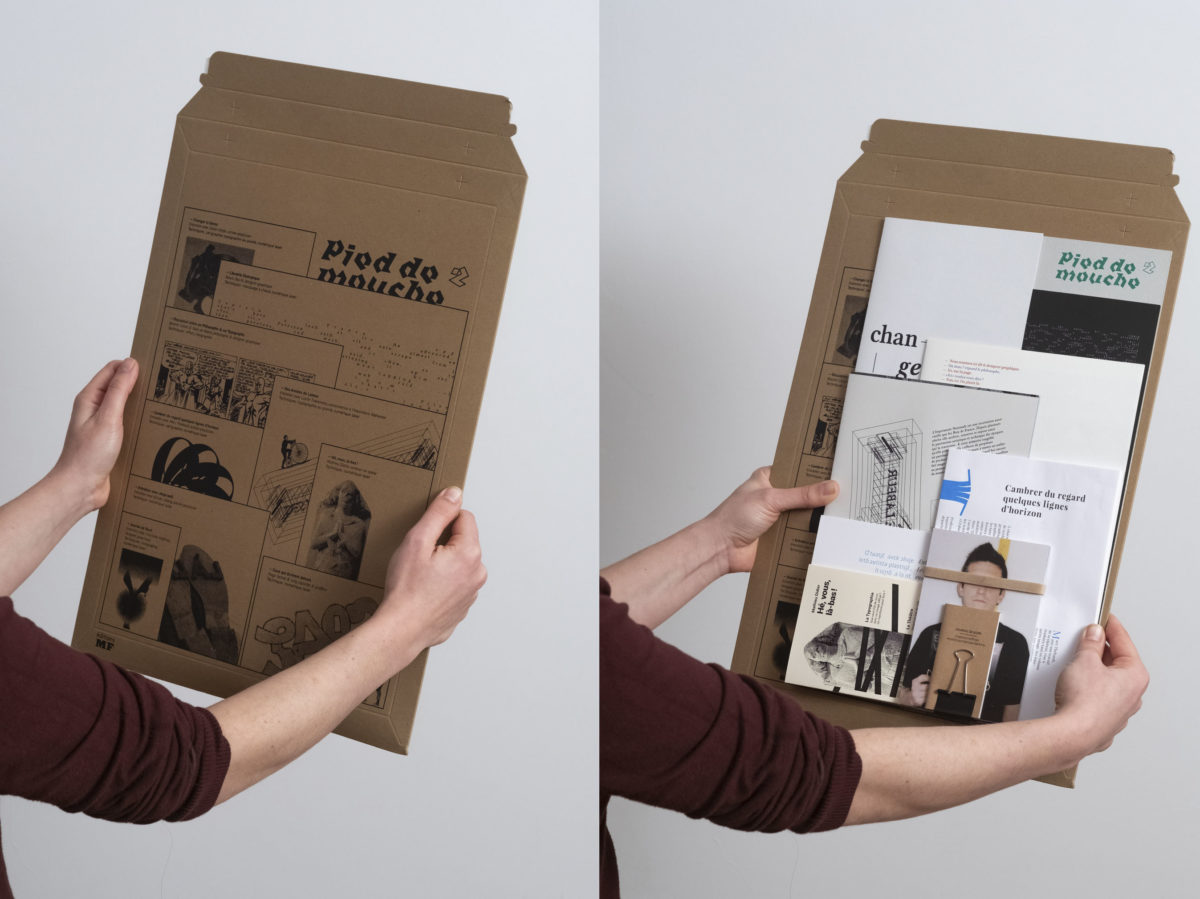

Pied de mouche is a typographic research magazine. The first issue followed the thematic of liberty and was published in 2015 with 1000 copies distributed for free in French schools of art, design and specialized bookstores.

Considering that type-design and graphic design face the challenges of ever-changing professions, Pied de mouche #2 seeks to understand and analyze those new mutations. To do so, Pied de mouche #2 bets on opening a typographic dialogue with its users instead of its designers. The team has chosen the formats of interviews and free contributions to converge views and reflections, inviting makers, authors, creators, and thinkers whose work does not necessarily take roots into the field of graphic design to understand their intimate relationship with the so-called character.

 Each chapter or article takes the form of a specific format, type font and printing process of its own, embodying its theme. The final product arose as a diversity of individual objects which answer the same research question.

The reader remains free to interconnect an article with another to merge its own very dialogues and interrogations.

With contributions from Marc Thébault, Lucille Théveneau, Bastien Gallet & Yoan de Roeck, Didier Kiefer, Alexis Zacchi, Olivier Létang, Charlotte Hoffman, Mathieu Didier and Loiq.


Contents

— Changing the Gesture

Interview with Didier Kiefer, visual artist 
Techniques: silk-screen printing, lead typography, digital laser

4 pages

— Dystopian bookshop
Alexis Zacchi, graphic designer
Techniques : marquage à chaud, numérique laser
2 pages

— Discussion between a Philosopher & a Typographer

Bastien Gallet & Yoan de Roeck, philosopher & graphic designer
Techniques: offset, risography
12 pages

— Years of Labour

Interview with Lucile Théveneau, curator at the Imprimerie Nationale
Techniques: lead typography, digital laser

8 pages

— Hey, you, over there!

Mathieu Didier, director
Technique: digital laser

6 pages

— Interview with ɔlivjeletɑ̃
Interview with Olivier Létang, visual artist
Technique: digital laser

2 pages

— Those who write outside
Hugo Serraz & Loiq, reporter & graffiti artist
Technique: digital laser

24 pages

— Journal de Bord
Interview with Charlotte Hoffman, graphic designer
Techniques: risography, digital laser
32 pages

French edition

Format 350 x 480

100 pages

40.00 €

To buy the book : https://www.editions-mf.com/produit/84/9782378040154/pied-de-mouche-2
ISSN : 2275-9344


Contre l’oggetto, Conversazioni sul design

Emanuele Quinz
Ed. Quodlibet
(Book available in Italian only)


“It is impossible to define design.” We increasingly come across this statement from design critics and historians. A habit? The admission of a real impossibility – to identify and limit the boundaries of a phenomenon that is too widespread or elusive? As if design were no longer a discipline within an artistic system, a professional and productive sector within an economic system, a field of techniques, concepts, practices and traditions within a cultural horizon, but rather a notion that lends itself to a form of universality: design is all these things, and much more”. It is therefore, strategically, through a series of conversations that Emanuele Quinz offers us in this volume a comparative analysis of this evolving discipline. The author uses his skills as a historian to penetrate the creative processes that are inextricably linked to art, and therefore not to strictly functional purposes. Paradoxically, much of recent design has been conceived against the idea that design is an infinite production of commercial objects, starting with the decisive exhibition Italy: The New Domestic Landscape held at MoMA in New York in 1972, which showcased Italian radical architecture. The personalities interviewed here thus constitute a generational sample that goes back to the pioneers of “counter-design” of the time, such as Ugo La Pietra and Gianni Pettena, the representatives of Dutch conceptual and critical design of the 1990s, and some of the main authors of today’s international scene, such as Martino Gamper, the Bouroullec brothers or Matali Crasset.

The resulting picture helps to clarify the nature of design in the 21st century, without neglecting the plurality of positions, or the transmigration of ideas made possible by the special status of this material, which is fortunately an intermediary between art and industry, and which is also becoming more and more decisive for the fate of architecture and town planning in our time.

Conversations with Giovanni Anceschi, Aldo Bakker, Gijs Bakker, Jurgen Bey, Pieke Bergmans, Erwan & Ronan Bouroullec, Elio Caccavale, Pierre Charpin, Matali Crasset, Didier Fiuza Faustino, Martino Gamper, Hehe, Ugo La Pietra, Matthieu Lehanneur, Mathieu Mercier, Gianni Pettena, Robert Stadler, Wieki Somers, Superflex, Clino Trini Castelli, avec la complicité de Tony Côme, Francesca Cozzolino, Jehanne Dautrey, Catherine Geel, Mari Linman, Luca Marchetti and Guido Musante.
16,7 x 24 cm
320 + XVI pages 
28 €
ISBN: 9788822903266

Website: https://www.quodlibet.it/libro/9788822903266

Interactivité collective et immersion : vers un nouveau régime d’expérience ?


Claire Chatelet, Corvo Lepesant-Lamari, Caroline San Martin, “La fémis présente n°1 : la réalité virtuelle, une question d’immersion !”, Rouge Profond, December 2019.

Livres mécaniques et chimères numériques


Alexia de Visscher, Chloé Delaume, Dan Rubin, Étienne Mineur, Johanna Drucker, Lucile Haute, Nathan Jones, Nicolas Tilly, Sam Skinner, Vilém Flusser, Yves Citton, “BACK OFFICE #3 Design graphique et pratiques numériques”, B42-112, September 2019.

For more information, please refer to:
http://www.ensadlab.fr/fr/francais-publication-back-office-3-ecrire-lecran/

Livres mécaniques et chimères numériques

For more information, please go to this website:
http://www.ensadlab.fr/fr/francais-publication-back-office-3-ecrire-lecran/

staatliche bauhaus – cent pour cent 1919-2019

(Book available in French only)

David Bihanic (dir.)
Paris, Ed. T&P Publishing, 2019

2019: the bauhaus founded and directed until 1928 by the architect Walter Gropius celebrates its 100th year. More than a school, it was a ‘heart’, a ‘center’ from which ‘sprang up’ creations, projects, inventions, theories, as well as new ideas for a firmly modern life. Forced to close, its ‘flames’ will grow across the Atlantic, but also in the Soviet republics as far as Japan or India… Its pioneer ‘animators’ are among the greatest artists of the twentieth century — to mention some of the most illustrious: Josef Albers, Herbert Bayer, Marcel Breuer, Wassily Kandinsky, Ludwig Mies van der Rohe, Hannes Meyer, Paul Klee, László Moholy-Nagy. Even today, every school of Art, Architecture and/or Design (likewise those devoted to Applied Arts), whether newly established and reformed, never avoid referring to the spirit of the bauhaus.

Exploring this precious heritage, the short texts written by 35 French artists, designers and theoreticians, all researchers, take and comment. Taken together, they form a subjective and precise archive which deconstructs ‘myths’, raises questions, opens up avenues of reflexion and then allows to discover essential and every so often unusual aspects of the bauhaus period, and the years that followed. The images, sometimes rare or widely known, illustrate and occasionally contribute to form the selection of 100 entries: objects, drawings, plans and diagrams, sentences and key phrases, notes, documents and photographic traces, all of these ‘contents’ bear witness of certain key moments as well as special ways to live and think.

Authors
• Alexandre Mare, Villa Noailles, Hyères, France
• Alexandra Midal, “Haute École d’Art et de Design” (HEAD), Geneva, Swiss
• Alice Savoie, University of Reading, England; ANRT, Nancy, France
• Antonella Tufano, Paris La Villette National Higher School of Architecture, France
• Brice Genre, A+B design studio; University of Toulouse Jean Jaurès, France
• Building Paris (Guillaume Grall, Benoît Santiard), Graphic design studio, Paris; “École d’architecture de la ville & des territoires” in Marne-la-Vallée, France
• Catherine Chomarat, University of Paris 1 Pantheon-Sorbonne, Paris, France
• Catherine Geel, Nancy School of Art and Design; “École Normale Supérieure” in Cachan; Sciences-Po, Paris, France
• Christophe Viart, University of Paris 1 Pantheon-Sorbonne, Paris, France
• Clara Salomon, “École nationale supérieure des Beaux-Arts”, Paris, France
• Claire Brunet, “École Normale Supérieure” in Cachan, France
• David Bihanic, University of Paris 1 Pantheon-Sorbonne; “École nationale supérieure des Arts Décoratifs”, Paris, France
• David Énon, “École supérieure d’art et de design” Tours-Angers-Le Mans, France
• Éléonore Challine, University of Paris 1 Pantheon-Sorbonne, Paris, France,
• Emanuele Quinz, University of Paris 8; “École nationale supérieure des Arts Décoratifs”, Paris, France
• Erik Verhagen, Polytechnic University of Hauts-de-France, Valenciennes, France
• François Perrodin, Regional School of Fine Arts of Rennes; Oniris art gallery, Rennes, France
• Gwenaëlle Bertrand, Jean-Monnet University, Saint-Étienne, France,
• Jean-Louis Fréchin, Nodesign agency, Paris, France
• Jocelyne Le Boeuf, “L’École de design Nantes Atlantique”, France
• Pierre Litzler, University of Strasbourg, France
• Maxime Favard, University of Strasbourg, France
• Michel Le Belhomme, Binome art gallery, Paris, France
• officeeabc (Brice Domingues, Catherine Guiral), Graphic design studio, Paris, France
• Patricia Ribault, Humboldt University of Berlin, Germany
• Pierre-Damien Huygue, University of Paris 1 Pantheon-Sorbonne, Paris, France
• Philippe Million, Alain Gutharc art gallery, Paris, France
• Ruedi Baur, “École nationale supérieure des Arts Décoratifs”, Paris, France; “Haute École d’Art et de Design” (HEAD), Geneva, Swiss; University of Strasbourg, France
• Stéphane Boudin-Lestienne, Villa Noailles, Hyères, France
• Stéphane Dupont, independent graphic designer, Paris, France
• Sophie Fétro, University of Paris 1 Pantheon-Sorbonne, Paris, France
• Thierry Chancogne, founder of t-o-m-b-o-l-o.eu editions and Ravisius Textor space, Nevers, France


14,8 x 21 cm
166 pages
22 €
ISBN: 9-78493-148055

Websites:
https://nouveautes-editeurs.bnf.fr/annonces.html?id_declaration=10000000516386&titre_livre=staatliche_bauhaus_cent_pour_cent_1919-2019
http://tpworkunit.com/

Towards Organogenesis: For an Instrumental Approach in Research in Art


Samuel Bianchini, “Towards Organogenesis: For an Instrumental Approach in Research in Art”, in Media-N, Research-Creation: Explorations, Owen Chapman, Louis-Claude Paquin, Louise Poissant, Kim Sawchuk (under the dir.), Journal of the New Media Caucus, vol.11 n°3, winter 2015.

Download here:
↓ Bianchini S. – Towards Organogenesis.en

Art & Design : poser des conditions d’expérimentation en commun


Samuel Bianchini, “Art & Design : poser des conditions d’expérimentation en commun”, in David Bihanic, Design en regards, Art Book Magazine, Paris, 2019, pp.136-149.

Download here:
↓ Bianchini S. – Art & Design

Maintenance, maintenant, main tenant

Samuel Bianchini and Emanuele Quinz


“Maintenance, maintenant, main tenant”, in Marie-Ange Brayer et Olivier Zeitoun (under the dir.), La Fabrique du vivant, Ed. HYX et Centre Georges Pompidou, Orléans, Paris, 2019, pp.104-115.

Download here:
↓ Bianchini S. Quinz E. – Maintenance, maintenant, main tenant

Field Essays: Meanderings in the field of decolonial design

Photo credit: Onomatopee

Sophie Krier (dir.)
Ed. Onomatopee, 2019

This issue of Field Essays brings to the fore the research Éloj Kréyol by design-duo dach&zephir (Florian Dach and Dimitri Zephir). Initiated in 2015, Éloj Kréyol is an attempt to reconcile, and reactivate neglected artisanal and cultural lifelines in the genealogy of the French Caribbean archipelago.

The five meanders that structure this book are invitations to ponder on the hidden biographies of archival images (Encounter between Dimitri Zephir, Florian Dach and X, edited by Sophie Krier); the enduring creolisation and alienation processes in Martiniquan society (Creole Voices by André Lucrèce); the material ingenuity of a water jar, a simple kitchen knife, and a basket (Mapping Histories by dach& zephir); the richness’s and unknowns of a collaboration across cultures in the field of design (Design as Relationality, Aesthetics as Agency: on dach& zephir by Lucy Cotter); the circulation of aes¬thetic norms at the turn of the century (The Creole Ninfa by Thomas Golsenne); and our legacy to the upcoming generation (Nasyon A Ti Kréyol, Design as Transmission). Bon lekti! Wishing you a good read!

Field Essays is a multi-faceted research that connects research posture in art/design with perspectives from other fields of knowledge (scientific / vernacular). It takes the form of short residencies, workshops, round tables and hybrid publications combining emerging know-how, practice and contemporary thinking. Both an object idea and an object of research communication, making it public and happening, Field Essays is above all a meeting, and the restitution of this meeting. Dialogue (dia- through, between, logos, speech, discourse) is its main mode of operation. Field Essays thus takes the form of a multi-vocal conversation platform that explores peripheral practices in search of neglected / forgotten / neglected topics, methods and terrains. Through Field Essays, practitioners and thinkers are joined together to establish a framework for shared reflection. Field Essays seeks to deepen and support unknown / emerging artistic practices, on the one hand, and to confront theoretical concepts with the material reticence of diverse practices, on the other. Field Essays was founded in 2008 by artist and researcher Sophie Krier, and is published by Onomatopee (Netherlands).

This issue of Field Essays had the support of Creative Industries Fund NL, Onomatopee Projects, Provincie Brabant, Atelier Sophie Krier, EnsadLab – PSL Université Paris and of the authors © 2019


Authors: dach&zephir; Lucy Cotter; André Lucrèce; Thomas Golsenne; Sophie Krier (dir.)
Graphic design: Inedition

Languages: English and Creole, with French summaries

17 x 24 cm
96 pages
20 €
ISBN: 9-78493-148055

Websites:
www.fieldessays.net
www.onomatopee.net
https://stimuleringsfonds.nl/nl/subsidies/deelregeling_vormgeving/

Publications

Design en regards

Book available in French

David Bihanic (dir.)
Paris/Saint-Étienne, Ed. Art Book Magazine (ABM) — EnsAD — La Cité du design, 2019.

To what may the difference in how Design is taught be attributed today? The fundamentals of its teachings are in a state of relative upheaval, and the trend seems to be moving gradually away from an approach rooted in the one-way transmission of its history, culture and theory, and more closely towards one rooted in mutual learning and practice. Johannes Itten and Walter Gropius firmly believed that Design Education was closely tied to the evolution of the inner being and the accomplishments related thereto, and was, in no way, to be a hindrance to the creative process or potential. For others, though, the field is the sole means to knowledge acquisition through the pooling of both think-how and design-how, enabling greater subjectivity and fostering an enlightened and free conscientiousness. The texts gathered in this volume attest to the diversity of myriad players in the French-speaking community of Design Teaching, and attempt to shed light on a question that is not only complex, but also crucial.


Design en regards is a collection of texts, interviews and testimonies.

In collaboration with Ecole nationale supérieure des Arts Décoratifs—Université Paris Sciences et Lettres(EnsAD—PSL) and La Cité du Design.
With the support of Université Paris 1 Panthéon-Sorbonne and Université Polytechnique des Hauts-de-France.

155 x 240 mm
497 pages
22€
ISBN: 978-2-8216-0115-4

Website for the printed edition: lespressesdureel.com

Publications

Sciences du design 08 Éditions numériques

(Book available in French only)

Renée Bourassa, Lucile Haute & Gilles Rouffineau (dir.)
Paris, Ed. puf, 2019.

Le numéro de Sciences du design thématisé autour des éditions numériques vient de paraître. Lancement à la librairie des puf le 18 janvier 2019.

Il est co-dirigé par Renée Bourassa (École de design de l’Université Laval, Québec), Lucile Haute (UNÎMES et EnsadLab) et Gilles Rouffineau (École Supérieure d’Art et Design • Valence).
Il réunit des articles de Robin de Mourat, Antoine Fauchié et Thomas Parisot, Nicolas Sauret, Anthony Masure, Florence Jamet-Pinkiewicz et des visualisations de Quentin Juhel (Les outils du design graphique), Julie Blanc et Lucile Haute (Technologies de l’édition numérique).
À retrouver en librairies et sur CAIRN. Sdd 08 Librairie des Puf_final.

Publications

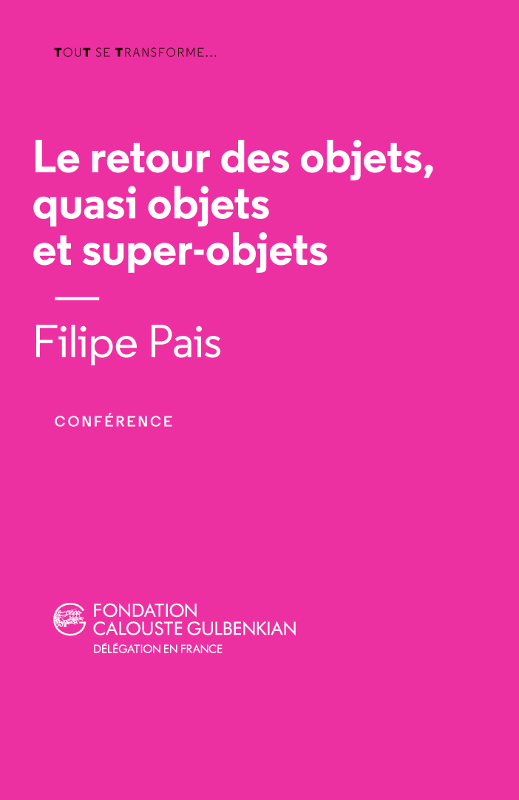
Le retour des objets, quasi objets et super-objets

(French conference)

Filipe Pais
Maia, Ed. Fondation Calouste Gulbenkian — French delegation, 2018.
A conference by Filipe Pais, March 20, 2018

A chair drops and kills a dictator. Windows, doors and other daily life objects mysteriously disappear. These are the themes of two short stories published in 1978 by José Saramago in Quasi Objets, one of his lesser known works. In his book, José Saramago introduces ordinary objects that come to life and free themselves from their function. These quasi objects are endowed with consciousness and intentionality. They can act on the world, emancipate from an anthropocentric existence and even take revenge on a confident master. What happens to the OUMIS (objects, utensils, machines or installations) in Quasi Objets? Why did they leave? Where did they go? Saramago does not provide us with final answers to these questions. One thing is for sure: the story must be continued… Which is the aim of the first conference of this cycle. At the intersection of art, philosophy and design, this conference invites us to reflect on the notion of Quasi Objects and its influence on Michel Serres and Bruno Latour’s works and to imagine another type of object: the Super Object.


A French edition
12 x 18.3 cm
44 pages
3.00 €
ISBN: 978-989-8935-01-4
Available at the the Foundation’s recception

Écrans mobiles : contexte technique et création artistique interactive


Dominique Cunin, “Écrans mobiles : contexte technique et création artistique interactive”, in Revue Théorème n°29, Mobiles, enjeux artistiques et esthétiques, Laurence Allard, Laurent Creton, Roger Odin (eds.), 2018, Presse Sorbonne Nouvelle, pp. 73-88.

Download here:
↓ Cunin D. – Ecrans mobiles

En quête de temps. Quand un dispositif artistique interactif convoque des expériences inédites du temps


Anne Bationo-Tillon, Francesca Cozzolino, “Enquête de temps. Quand un dispositif artistique interactif convoque des expériences inédites du temps”, Proceedings of the colloquium “Le numérique à l’ère des designs: de l’hypertexte à l’hyper-expérience.”, H2PTM 2017, Hermès, Lavoisier, 2017, pp.168-186.

Download here:
↓ Cozzolino F. Bationo-Tillon A.- En quête de temps

Behavioral Objects: The Rise of the Evocative Machines


Florent Levillain, Elisabetta Zibetti, “Behavioral Objects: The Rise of the Evocative Machines”, Journal of Human-Robot Interaction, vol.6 n°1, 2017, pp.4-24.

Download here:
↓ Levillain F. Zibetti E. – Behavioral objects.eng

The Aesthetic Experience of Time, in between the Hourglass and the Self


Hans Dieleman, Francesca Cozzolino, Anne Bationo, “The Aesthetic Experience of Time, in between the Hourglass and the Self”, in Transdisciplinary Journal of Engineering & Science, TheATLAS, vol.8, 2017, pp.193-206.

Download here:
↓ Cozzolino F. Dieleman H. Bationo A. – The Aesthetic Experience of Time.eng

From Instrumental Research in Art to its Sharing: Producing a commons, respecting the singular


Samuel Bianchini, “From Instrumental Research in Art to its Sharing: Producing a commons, respecting the singular”, in Hans Dieleman, Basarab Nicolescu, Atila Ertas Editors, Transdisciplinary & Interdisciplinary Education and Research, TheATLAS, Lubbock, Texas, USA, December 2017, pp.251-268.

Download here:
↓ Bianchini S. – From Instrumental Research in Art.eng

Art installations: a study of the topology of collective co-located interactions


Samuel Bianchini, David Bihanic, Pierre Cubaud, Oussama Mubarak, “Art installations: a study of the topology of collective co-located interactions”, ARTECH2017, Association for Computing Machinery, Macau, China, September 2017.

Download here:
↓ Mubarak O. Bihanic D. Cubaud P. Bianchini S. – Art intallations.eng

De temps en temps


Samuel Bianchini and David Arnaud, “De temps en temps”, in ID VERRE INFOS, n°64, Cerfav, 2017.

Download here:
↓ Bianchini S. Arnaud D. – De temps en temps.entretien

Du comportement des objets au comportements entre les objets


Samuel Bianchini, Amandine Bajou, Alexandre Saunier, “Du comportement des objets au comportements entre les objets”, in Inter, Art Actuel, n°125 “Connectivités”, 2017.

Download here:
↓ Bianchini S. Saunier A. Bajou A. – Du comportements des objets

En réseau, des expériences artistiques distribuées


Samuel Bianchini, Francesca Cozzolino, “En réseau, des expériences artistiques distribuées”, in FLUX NUMERO 100 > Artistes, chercheurs et réseaux, 2016.

Download here:
↓ Cozzolino F. Bianchini S. – En réseau

De l’agencement à l’agentivité. Opérer en contexte, opérer avec le contexte


Samuel Bianchini, “De l’agencement à l’agentivité. Opérer en contexte, opérer avec le contexte”, in Jean-Paul Fourmentraux (dir.), Images interactives : Arts, Sciences et Cultures du visuel, La lettre Volée, Brussels, coll. Essais, 2016, pp.89-116.

Download here:
↓ Bianchini S. – De l’agengement à l’agentivité

Recherche en Arts : Valeur pratique, valeur économique


Samuel Bianchini, “Recherche en Arts : Valeur pratique, valeur économique”, Les Cahiers de Culture & Démocratie, Culture & Démocratie, Brussels, 2016.

Download here:
↓ Bianchini S. – Recherche en arts

Disposer de contre-rôles


Samuel Bianchini and Igor Galligo, “Disposer de contre-rôles”, in Dispositifs artistiques et interactions situées, Bernard Guelton (under the dir.), Rennes, Ed. Presses Universitaire de Rennes, June 2016, pp. 147-165.

Download here:
↓ Bianchini S. Galligo I. – Disposer de contre-rôles.entretien

Moving on its Own: How do Audience Interacts with an Autonomous Moving Artwork


Sébastien Lefort, Florent Levillain, Elisabetta Zibetti, “Moving on its Own: How do Audience Interacts with an Autonomous Moving Artwork”, in Case Study: Art & Life, CHI 2015, Crossings, Seoul, Korea, 2015.

Download here:
↓ Levillain F. Lefort S. Zibetti E. – Moving on its own.eng

(Mis)behavioral Objects, Empowerment of Users vs Empowerment of Objects


Samuel Bianchini, Rémy Bourganel, Emanuele Quinz, Florent Levillain and Elisabetta Zibetti, “(Mis)behavioral Objects, Empowerment of Users vs Empowerment of Objects”, in Empowering Users through Design, David Bihanic, Cham, Switzerland, Ed. Springer, 2015.

Download here:
↓ Bianchini S. Bourganel R. Quinz E. Levillain F. Zibetti E. – (Mis)behavioral Objects.en

Audience Works. Étudier, par l’image, le public pratiquant des installations interactives


Samuel Bianchini, “Audience Works. Étudier, par l’image, le public pratiquant des installations interactives”, in À perte de vue, les nouveaux paradigmes du visuel, Daniel Dubuisson and Sophie Raux (under the dir.), Dijon, Ed. Les presses du réel, coll. Perceptions, 2015, pp.411-427.

Download here:
↓ Bianchini S. – Audience Works

Reverse Writing – De l’écriture audiovisuelle à l’écriture interactive : prises de vue et mises en scène à l’écran


Samuel Bianchini, “Reverse Writing – De l’écriture audiovisuelle à l’écriture interactive : prises de vue et mises en scène à l’écran”, in Cinéma, interactivité et société, VDMC, Brussels, Jean-Marie Dallet (ed.), 2013, pp.124-141.

Download here:
↓ Bianchini S. – Reverse Writing

La performation. Quand faire, c’est dire


Samuel Bianchini, “La performation. Quand faire, c’est dire”, in L’Ère post-média. Arts, Humanités digitales et Cultures numériques, Jean-Paul Fourmentraux (under the dir.), Ed. Hermann, coll. Cultures numériques, Paris, 2012, pp.137-162.

Download here:
↓ Bianchini S. – La performation. Quand faire, c’est dire

Playgame – Jouer sans fins ?


Samuel Bianchini and Jean-Baptiste Labrune, “Playgame – Jouer sans fins ?”, in E-Formes 2 – Au risque du jeu, Monique Maza and Alexandra Saemmer (under the dir.), Publications de l’Université de Saint-Étienne, February 2011, pp.167-175.

Download here:
↓ Bianchini S. Labrune J.-B. – Playgame

Voyager à l’écran. Déplacer l’image, se déplacer à l’image, se déplacer dans l’image


Samuel Bianchini, “Voyager à l’écran. Déplacer l’image, se déplacer à l’image, se déplacer dans l’image”, in Le voyage créateur. Expériences artistiques et itinérance, Eric Bonnet (under the dir.), Paris, Ed. L’Harmattan, Coll. Eidos, Retina series, February 2010, pp.273-285.

Download here:
↓ Bianchini S. – Voyager à l’écran

En Réalités. Stratification, indexation et disjonction dans la représentation


Samuel Bianchini and Sylvie Tissot, En Réalités. Stratification, indexation et disjonction dans la représentation, in revue Plastik#01 – Être ici et là : la relativité générale et la physique quantique, Richard Conte and Olga Kisseleva (under the dir.), Ed. Cerap – Université Paris 1 Panthéon-Sorbonne, Paris, January 2010.

Download here:
↓ Bianchini S. Tissot S. – En Réalités

Création et “Recherche & Développement”


Samuel Bianchini, Jean-Paul Fourmentraux and Emmanuel Mahé, “Création et « Recherche & Développement »”, in Valeurs croisées, Les Ateliers de Rennes – Biennale d’art contemporain #1 catalogue, Raphaële Jeune (under the dir.), Ed. Les presses du réel, Dijon, February 2009, pp.136-145 (French version), pp.180-189 (English version).

Download here:
↓ Bianchini S. Fourmentraux J.-P. Mahé E. – Création et R&D

Médias praticables : l’interactivité à l’œuvre


Samuel Bianchini, Jean-Paul Fourmentraux, “Médias praticables : l’interactivité à l’œuvre”, in Sociétés, n°96, De Boeck Université, 2007, pp.91-104.

Download here:
↓ Bianchini S. Fourmentraux J.-P. – Médias praticables

Exp. De l’expérimental à l’expérimentable


Samuel Bianchini, “Exp. – De l’expérimental à l’expérimentable”, in In actu – De l’expérimental dans l’art, Elie During, Laurent Jeanpierre, Christophe Kihm, Dork Zabunyan (under the dir.), Dijon, Ed. Les presses du réel, 2009, pp.285-304, 2009.

Download here:
↓ Bianchini S. – Exp. De l’expérimental à l’expérimentable

Recherche & Création


Samuel Bianchini, “Recherche et Création”, in Recherche & Création. Art, technologie, pédagogie, innovation, Samuel Bianchini (under the dir.), Ed. Burozoïque and Ecole nationale supérieure d’art de Nancy, Montrouge, 2009, pp.18-43.

Download here:
↓ Bianchini S. – Recherche & Création

The Theater of Operations


Samuel Bianchini, “Le Théâtre des opérations”, in Iconoclash – Beyond the image wars in science, religion, and art catalogue, Bruno Latour and Peter Weibel (under the dir.), Ed. ZKM, Center for Art and Media, Karlsruhe, Germany (French version), Massachusetts Institute of Technology, Cambridge, Massachusetts, MIT Press, May 2002, pp.483-485, translation by Jian-Xing Too.

Download here:
↓ Bianchini S. – The Theater of Operations

From Bits to Paper

Filipe Pais
Paris, Ed. Art Book Magazine, 2018.
Collection liteʁal directed by Lucile Haute
Graphic conception: EnsadLab and Jean-François Boulan

As the different assets of human culture become progressively dematerialized, and are archived in faraway data centers, we become ever more absorbed by our screens and depend on the mediation of increasingly complex and black-boxed algorithms. In response to this process, a curious counter-movement has emerged in the fields of art and design. Instead of following the trend of dematerialization, artists and designers have been reversing it by decontextualizing and rematerializing digital native elements. Out of their context, these uncanny elements gain a new tangible materiality, appearing in public spaces, in galleries or in the middle of nature. As they leave their native environment, they lose their functionality and become elements for contemplation that attempt to break the spell of transparent design.

Through a collection of interviews with and essays by artists and theoreticians, this book develops the reflections generated during the exhibition From Bits to Paper at Le Shadok in Strasbourg from March to June 2016.

With the contributions of: Aram Bartholl, James Bridle, Vincent Broquaire, Dominique Cardon, Martin De Bie, Julien Fargeton, Darko Fritz, Igor Galligo, Patricia Gouveia, Lucile Haute, Peter Jellitsch, Albertine Meunier, Esther Polak, Domenico Quaranta, Alexandre Saunier, Bernard Stiegler, Ivan Twohig, Clément Valla, Ivar Van Bekkum, Thierry Verbeeck.


Edité par Filipe Pais.

édition anglaise
24 x 32 cm (broché, couv. à rabat)
196 pages (ill. n&b)
27.00 €
ISBN : 978-2-8216-0095-9
Pour acheter l’ouvrage : http://www.lespressesdureel.com/ouvrage.php?id=6657

Data design. Les données comme matériau de création

(Book available in French only)

David Bihanic
Paris, Ed. Gallimard, 2018.

Que faire des données générées et échangées informatiquement chaque jour sur la planète ? Des données qui s’accumulent dans de gigantesques data centers et dont la quantité est telle que nous ne parviendrons bientôt plus à l’estimer. Comment faire face à ce déluge d’octets ? Comment le traiter ? Comment en profiter ?

En parallèle des scientifiques, ingénieurs et experts déjà attelés à ce travail titanesque d’ordonnancement et d’exploitation des masses de données, certains designers artistes relèvent le défi. Nouveaux explorateurs de la datasphère, ils s’emparent des données comme un véritable matériau de création.

Ce livre, dont la forme à multiples dépliants encourage la surprise et la déambulation, présente l’extraordinaire diversité des pratiques et des médiums : objets, sculptures, installations, infographies, visualisations interactives, etc. L’ensemble des productions ici rassemblées met en lumière le caractère immatériel des données et leur immanente présence.


Data design est le catalogue de l’exposition organisée à la fondation EDF (4 mai au 6 octobre 2018).

15 x 20 cm
64 pages avec 8 dépliants
14.90 €
ISBN : 978-207279-200-7
Site de l’éditeur : http://www.editionsalternatives.com/site.php?type=P&id=2061

À Distances. Œuvrer dans les espaces publics

(Book available in French only)

Samuel Bianchini and Mari Linnman
Dijon, Ed. Les Presses du Réel, 2017.

Réaliser des œuvres d’art dans les espaces publics reste un défi : comment, dans ces lieux caractérisés par de nombreuses sollicitations et activités, provoquer des expériences esthétiques et constituer un public ? Sans tomber dans les travers du monumental ou du décoratif, comment concevoir des œuvres qui interpellent subtilement nos sens ou provoquent des concernements, voire induisent des pratiques alternatives aux usages convenus ?

Dans cet ouvrage, Samuel Bianchini et Mari Linnman reviennent sur ces différents registres d’expériences. Ils interrogent diverses façons de faire œuvre dans les espaces publics à partir de leurs positions mutuelles et d’un cas d’étude : À Distances (2011 – 2014), une œuvre qu’ils ont produite ensemble dans le cadre de l’action Nouveaux commanditaires de la Fondation de France pour la Maison du geste et de l’image, aux Halles, au cœur de Paris.


Un livre édité par les Presses du réel
Collection Société des Nouveaux commanditaires

Texte établi avec la collaboration de Cyrille Latour
Design graphique : Bertrand Sandrez
Assistanat éditorial : Élodie Tincq
Relecture : Pierre-André Orillard La publication de cet ouvrage a été possible grâce au soutien de la Fondation de France,
de l’Université Paris 8 et du Labex Arts-H2H au titre du programme Investissement d’avenir
(ANR-10-LABX-80-01).

édition française
12,5 x 21 cm (broché, couv. à rabats)
144 pages (ill. coul. et n&b)
9.00 €
ISBN : 978-2-84066-958-6
Pour acheter l’ouvrage : www.lespressesdureel.com

Le cercle invisible. Environnements, systèmes, dispositifs

(Book available in French only)

Emanuele Quinz
Dijon, Ed. Les Presses du Réel, 2017.

« Le public est dans le cercle parce que nous vivons en cercle. […] L’art nous apprend à vivre dans le cercle » expliquait, en 1967, John Cage dans un entretien.
Et c’est bien la voie que l’art entreprend avec les expérimentations des avant-gardes du début du siècle dernier, avec les pratiques de l’installation, de la participation ou de la relation des années 1960 et 1970, et plus récemment, avec les recherches technologiques des années 1990. Les artistes se détournent des objets pour explorer l’installation, la participation, la relation, l’interaction.

Analysant ces transformations dans une perspective interdisciplinaire, où les arts plastiques croisent la musique, les arts de la scène ou la performance, les essais réunis dans ce volume, écrits « sur le terrain », se déploient en parcours et convergent sur la définition d’un art sans objet, qui, comme un cercle invisible, entoure le public – tout à la fois environnement, système, dispositif.


Un livre édité par les Presses du réel
Collection Figures

édition française
15 x 21 cm (broché, couv. à rabats)
336 pages (ill. n&b)
22.00 €
ISBN : 978-2-84066-840-4
Pour acheter l’ouvrage : http://www.lespressesdureel.com/ouvrage.php?id=5910

Practicable – From Participation to Interaction in Contemporary Art

Samuel Bianchini and Erik Verhagen with the collaboration of Nathalie Delbard and Larisa Dryansky.
Cambridge / London, Ed. The MIT Press, 2016.

How are we to understand works of art that are realized with viewers’ physical involvement? How are we to analyze a relationship between a work of art and its audience that is rooted in an experience both aesthetic and physical when “user experience” is a central concern of a society held in the grip of omnipresent interactivity? Between two seemingly opposed modes, contemplation and use, this book offers a third option: that of “practicable” works, made for and of audience action. Today, these works often use digital technologies, but artists have created participatory works since the mid-twentieth century. In this volume, critics, writers, and artists provide diverse perspectives on this kind of “practicable” art, discussing and documenting a wide variety of works from recent decades. Practicable returns to the mainstays of contemporary art from the 1950s to the present, examining artistic practices that integrate the most forward-looking technologies, disregarding the false division between artworks that are technologically mediated and those that are not. Practicable proposes a historical framework to examine art movements and tendencies that incorporate participatory strategies, drawing on the perspectives of the humanities and sciences. It investigates performance and exhibition, as well as key works by artists including Marina Abramović, Janet Cardiff, Lygia Clark, Piotr Kowalski, Robert Morris, David Rokeby, and Krzysztof Wodiczko, and features interviews with such leading artists and theoreticians as Matt Adams of Blast Theory, Claire Bishop, Nicolas Bourriaud, Thomas Hirschhorn, Bruno Latour, Seiko Mikami, and Franz Erhard Walther.


Published by MIT Press, Leonardo Book Series.
952 pp. | 7 x 9 in | 164 b&w illus. | October 2016
Hardcover | $50.00 | £41.95 | ISBN: 9780262034753
For more informations and to buy: https://mitpress.mit.edu/books/practicable

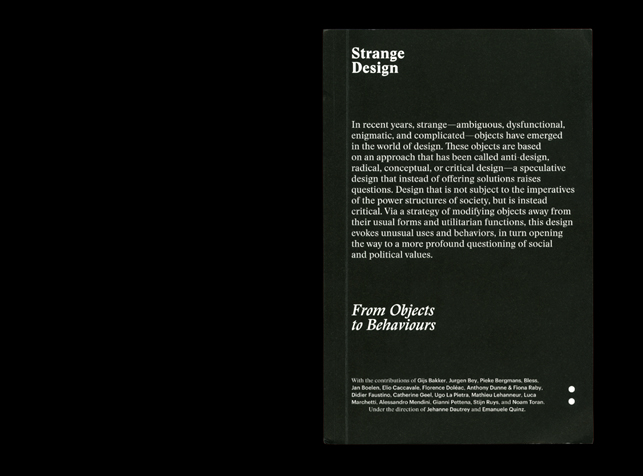
Strange Design. From Objects to Behaviors

(Click here for the French edition)

Jehanne Dautrey & Emanuele Quinz
Idea Books, 2016

In recent years, strange — ambiguous, dysfunctional, enigmatic, and complicated — objects have emerged in the world of design. These objects are based on an approach that has been called anti-design, radical, conceptual, or critical design — a speculative design that instead of offering solutions raises questions. Design that is not subject to the imperatives of the power structures of society, but is instead critical. Via a strategy of modifying objects away from their usual forms and utilitarian functions, this design evokes unusual uses and behaviors, in turn opening the way to a more profound questioning of social and political values.

With the contributions of Gijs Bakker, Jurgen Bey, Pieke Bergmans, Bless, Jan Boelen, Elio Caccavale, Florence Doléac, Anthony Dunne & Fiona Raby, Didier Faustino, Catherine Geel, Ugo La Pietra, Mathieu Lehanneur, Luca Marchetti, Alessandro Mendini, Gianni Pettena, Stijn Ruys, and Noam Toran.

With the support of the Ecole nationale supérieure des Arts Décoratifs in Paris and the Ecole Nationale Supérieure d’Art et de Design in Nancy, as well as the “Scènes du Monde, Création, Savoirs Critiques” Université Paris 8 Research Unit (EA 1573).


Artistic direction: Ludovic Burel
Graphic design: Clément Le Tulle-Neyret
Translation from French into English: Jonathan & David Michaelson (JD-Trad)

15 x 23 cm
380 pages
30 €
ISBN: 978 2 917053 26 3
Website: http://www.readit.fr/index.php?/catalogue/strange-design-us/

Behavioral Objects 1. A Case Study: Céleste Boursier-Mougenot

Samuel Bianchini and Emanuele Quinz
Berlin / New York, Ed. Sternberg Press, 2016.

Three grand pianos slowly make their way through the large exhibition space allotted to them, sometimes bumping into one another. These animate objects, which constitute offroad (2014), a work by the artist Céleste Boursier-Mougenot, appear to be living beings, each with its own behavior. They are perfect examples of behavioral objects, whose little-known history dates back to the avant-garde and the emergence of cybernetics.

What exactly is a behavioral object? How can it be analyzed, understood, theorized, experienced, and how can we conceive of works that possess the faculty of action and reaction to their environment and public? Examining three works by Céleste Boursier-Mougenot, this book tackles these questions and defines a new field of research and practice.


Contributions by Samuel Bianchini, Céleste Boursier-Mougenot, Jaime DeSimone, Jean-Paul Laumond, Florent Levillain, Emanuele Quinz, Bénédicte Ramade, Trevor Smith, Elisabetta Zibetti

Published by Sternberg Press and École nationale supérieure des Arts Décoratifs – Paris PSL Research University
With the support of the Université Paris 8 and Labex Arts-H2H
Design by Bertrand Sandrez

16.5 x 23 cm
224 pages (52 b/w and 50 color ill., softcover)
€16.00
ISBN: 978-3-95679-172-7
Website: http://www.sternberg-press.com/index.php?pageId=1683&bookId=576&l=en

New Challenges for Data Design

David Bihanic
London, Ed. Springer, 2015.

The present work provides a platform for leading Data designers whose vision and creativity help us to anticipate major changes occurring in the Data Design field, and pre-empt the future. Each of them strives to provide new answers to the question, “What challenges await Data Design?”. To avoid falling into too narrow a mind-set, each works hard to elucidate the breadth of Data Design today and to demonstrate its widespread application across a variety of business sectors. With end users in mind, designer-contributors bring to light the myriad of purposes for which the field was originally intended, forging the bond even further between Data Design and the aims and intentions of those who contribute to it. The first seven parts of the book outline the scope of Data Design, and presents a line-up of “viewpoints” that highlight this discipline’s main topics, and offers an in-depth look into practices boasting both foresight and imagination. The eighth and final part features a series of interviews with Data designers and artists whose methods embody originality and marked singularity.

As a result, a number of enlightening concepts and bright ideas unfold within the confines of this book to help dispel the thick fog around this new and still relatively unknown discipline. A plethora of equally eye-opening and edifying new terms, words, and key expressions also unfurl. Informing, influencing, and inspiring are just a few of the buzz words belonging to an initiative that is, first and foremost, a creative one, not to mention the possibility to discern the ever-changing and naturally complex nature of today’s datasphere.

Providing an invaluable and cutting-edge resource for design researchers, this work is also intended for students, professionals and practitioners involved in Data Design, Interaction Design, Digital & Media Design, Data & Information Visualization, Computer Science and Engineering.


447 pages
€179.34 (Hardcover)
ISBN: 978-1-4471-6595-8
Website: https://www.springer.com/fr/book/9781447165958

Empowering Users Through Design. Interdisciplinary Studies and Combined Approaches for Technological Products and Services

David Bihanic
Cham (Switzerland), Ed. Springer, 2015.

At the crossroads of various disciplines, this collective work examines the possibility of a new end-user “engagement” in ongoing digital/technological products and services development. It provides an overview of recent research specifically focused on the user’s democratic participation and empowerment. It also enables readers to better identify the main opportunities of participatory design, a concept which encourages the blurring of the role between user and designer. This allows people to escape their status as “end-user” and to elevate themselves to the level of creator.

This book explores new avenues for rethinking the processes and practices of corporate innovation in order to cope with current socio-economic and technological changes. In so doing, it aims to help companies renew industrial models that allow them to design and produce new ranges of technological products and services by giving the user an active role in the development process, far beyond the basic role of consumer.

Intended for designers, design researchers and scientists interested in innovation and technology management, this book also provides a valuable resource for professionals involved in technology-based innovation processes.


284 pages
€147.69
ISBN: 978-3-319-13017-0
Website: https://www.springer.com/fr/book/9783319130170

Esthétique des Systèmes

(Book available in French only)

Jack Burnham and Hans Haacke
Dijon, Ed. Les Presses du Réel, 2015

« On assiste de nos jours au développement d’une polarité entre l’œuvre finie et unique du « grand art », c’est-à-dire de la peinture ou de la sculpture, et des réalisations qui peuvent approximativement être désignées comme non-objets, ceux-ci étant des environnements ou des artéfacts qui résistent à la l’analyse critique en vigueur… » – Jack Burnham

En 1968, Jack Burnham propose d’utiliser le terme « systèmes » pour définir les pratiques artistiques de ces années-là, qui semblent dépasser le statut traditionnel de l’œuvre comme objet. Dans deux essais célèbres, parus dans la revue Artforum (System Esthetics, 1968 ; Real Time Systems, 1969), dont nous publions ici la première traduction française, Burnham dessine le profil d’une « esthétique des systèmes » : comme une perspective relationnelle qui relie des éléments hétérogènes, des dispositifs technologiques mais aussi des organismes vivants.

L’artiste Hans Haacke adopte le même terme pour décrire ses œuvres des années 1960, dans lesquelles il expose des phénomènes physiques et naturels. Mobilisant un intense débat à son époque, la « pensée des systèmes » est loin d’avoir perdu son actualité : sous des formes et des noms différents, elle imprègne le monde de l’art actuel.


Collection Labex
Edité par Emanuele Quinz
Préface d’Emanuele Quinz
Postface de Caroline A. Jones

Traduction de l’anglais (américain) par Franck Lemonde
édition française
12,2 x 19 cm (broché)
168 pages (ill. n&b)
16.00 €
ISBN : 978-2-84066-793-3
Pour acheter l’ouvrage : http://www.lespressesdureel.com/ouvrage.php?id=3853

Strange Design. Du design des objets au design des comportements

(Click here for the English edition)

Jehanne Dautrey et Emanuele Quinz
Villeurbanne, it: éditions, 2014

Depuis quelques années ont fait leur apparition dans le monde du design des objets étranges : des objets dysfonctionnels, énigmatiques, compliqués. Ces objets relèvent d’une posture que les designers anglais Anthony Dunne et Fiona Raby ont défini Critical Design (design critique) : un design spéculatif, réflexif, qui ne veut pas proposer des solutions, mais plutôt poser des questions, qui veut défier les affirmations rapides, les préjugés et lieux communs sur le rôle des produits dans la vie de tous les jours. Un design qui ne se veut pas affirmatif, c’est-à-dire soumis aux impératifs des systèmes de pouvoir, mais au contraire critique.

Cette « attitude » n’est pas nouvelle, mais a, au contraire, une histoire, qui longe la frontière entre art et design.

L’objectif de cet ouvrage n’est pas de reparcourir cette histoire de manière exhaustive ou linéaire, mais plutôt d’en envisager quelques épisodes afin de dégager les outils critiques dont ils sont porteurs pour l’histoire du design — comme une sismographie qui indique les résurgences de la crise d’un modèle.

Quatre moments de l’histoire du design ont été choisi : le Design Radical italien (à partir de 1967 – jusqu’à Alchimia et Memphis qui en constituent en quelque sorte une forme d’épilogue), le design conceptuel néerlandais des années 1990, le Critical Design anglais des années 2000, pour ouvrir sur la scène contemporaine (notamment en France).


Direction artistique : Ludovic Burel.
Conception graphique : Clément Le Tulle-Neyret.

15 x 23 cm (broché)
380 pages
28.00 €
ISBN : 978-2-917053-18-8.
Site de l’éditeur : http://www.readit.fr/index.php?/catalogue/strange-design/

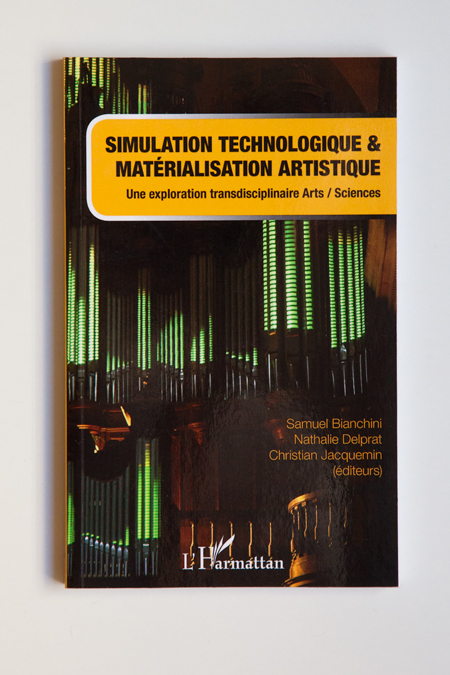
Simulation technologique & matérialisation artistique. Une exploration transdisciplinaire Arts / Sciences

(Book available in French only)

Samuel Bianchini, Nathalie Delprat and Christian Jaquemin
Paris, Ed. L’Harmattan, 2011.

S’appuyant principalement sur les technologies numériques, la simulation n’a cessé de se développer depuis une trentaine d’années. Aujourd’hui, la création artistique comme la recherche scientifique semblent préoccupées par les liens existant entre les univers numériques et le monde physique, et par les relations à inventer entre la simulation et de nouvelles formes de matérialisation : médias tangibles, prototypage rapide, physical computing, internet des objets, interfaces mixtes, réalité augmentée, captation gestuelle…

Cet ouvrage offre une vue d’ensemble des nombreux champs traversés par cette problématique. Il permet de découvrir des réalisations interdisciplinaires impliquant des contributions artistiques et scientifiques, ainsi que des textes critiques analysant l’impact de la simulation sur nos pratiques en sciences et en art contemporain. Du lecteur curieux d’avoir un aperçu de l’état de la recherche sur ces sujets au spécialiste désireux d’enrichir sa vision par une approche croisée, ce livre donne matière à réflexion et à discussion quant aux nouvelles pratiques et théories de la simulation et leurs possibles impacts sociétaux.


Un livre édité par L’Harmattan

135 x 215 cm
194 pages
19.50 €
ISBN : 978-2-296-55938-7
Pour acheter l’ouvrage : http://www.editions-harmattan.fr/index.asp?navig=catalogue&obj=livre&no=35795

Recherche & Création. Art, technologie, pédagogie, innovation

(Book available in French only)

Samuel Bianchini
Montrouge, Ed. Burozoïque and École nationale supérieure d’art de Nancy, 2009.
Re-issued in electronic format in January 2012, by Art Book Magazine [artbookmagazine.com].

Pour permettre un investissement pratique, critique et prospectif d’envergure dans un rapport renouvelé et négocié aux technologies, il est aujourd’hui essentiel de positionner la création artistique comme un domaine de la Recherche, reconnu en tant que tel, et associé aux réseaux d’excellence déjà constitués dans les autres disciplines. En France, à l’instar de l’École nationale supérieure d’art de Nancy, quelques établissements se sont engagés dans cette voie et ont initié d’ambitieux projets de laboratoires, ateliers, post-diplômes et cycles de recherche. Après dix années d’expérience et de prospection dans ce domaine au sein du réseau Artem, au côté de l’École des Mines et de l’École de Management (ICN Business School) de Nancy, l’École nationale supérieure d’art de Nancy associé au jeune éditeur Burozoïque a souhaité rendre compte de cette nouvelle dynamique nationale.

En prise avec les technologies, ce que nous nommons « Recherche & Création » n’est plus un vain mot. Mais la « R&C » introduit de nouvelles perspectives autant que de nombreuses questions. Elle requiert un travail collectif nécessitant une articulation des compétences, en particulier entre création et ingénierie. Elle entraîne à renouer en profondeur avec la technique. Elle renouvelle les liens entre pratique et théorie. Elle dynamise les opportunités de dialogue avec d’autres disciplines – en particulier scientifiques – et d’autres secteurs, comme l’industrie. Elle oblige à reconsidérer nos modes d’exposition, de diffusion des œuvres et de relation au public. Elle réagence une économie de l’art, marquée elle aussi par le marché. En contexte pédagogique, elle redistribue les rôles entre artistes, enseignants chercheurs et étudiants. Et elle permet de rejoindre la stratégie internationale d’essor et de rayonnement des grandes institutions de recherche et de formation. Si le mouvement est maintenant amorcé et commence à être compris des décideurs tant publics que privés, qui y voient aussi, à juste titre, une opportunité de développement, d’innovation et de valorisation, il reste encore largement à consolider.

S’appuyant sur ces expériences significatives et sur la vision de personnalités, artistes et chercheurs du domaine, cet ouvrage dirigé par Samuel Bianchini (artiste et enseignant-chercheur) propose les bases d’une véritable politique de Recherche & Création avec les technologies, à la confluence des arts contemporains, des milieux de la recherche, de la pédagogie et de l’innovation.


Collectif sous la direction de Samuel Bianchini : Jean-Louis Boissier, Christophe Bruno, Dominique Cunin, Jean-Marie Dallet, Marie Duchêne, Hélène Perreau & Jean-François Robardet, Jean-Paul Fourmentraux, Thierry Fournier, Antonio Guzmán, Jérôme Joy & Peter Sinclair, David-Olivier Lartigaud, Christophe Leclercq, Emmanuel Mahé, Hélène Rambert

édition française
15 x 21 cm
264 pages
17.00 €
ISBN : 978-2-917130-11-7
Pour acheter l’ouvrage : http://www.paris-art.com/recherche-et-creation-art-technologie-pedagogie-innovation/
Site internet de Art Book Magazine : artbookmagazine.com

Pied de mouche #2 : Typographical dialogues
Contre l’oggetto, Conversazioni sul design
Interactivité collective et immersion : vers un nouveau régime d’expérience ?
Livres mécaniques et chimères numériques
staatliche bauhaus – cent pour cent 1919-2019
Towards Organogenesis: For an Instrumental Approach in Research in Art
Art & Design : poser des conditions d’expérimentation en commun
Maintenance, maintenant, main tenant
Field Essays: Meanderings in the field of decolonial design
Design en regards
Sciences du design 08 Éditions numériques
Le retour des objets, quasi objets et super-objets
Écrans mobiles : contexte technique et création artistique interactive
En quête de temps. Quand un dispositif artistique interactif convoque des expériences inédites du temps
Behavioral Objects: The Rise of the Evocative Machines
The Aesthetic Experience of Time, in between the Hourglass and the Self
From Instrumental Research in Art to its Sharing: Producing a commons, respecting the singular
Art installations: a study of the topology of collective co-located interactions
De temps en temps
Du comportement des objets au comportements entre les objets
En réseau, des expériences artistiques distribuées
De l’agencement à l’agentivité. Opérer en contexte, opérer avec le contexte
Recherche en Arts : Valeur pratique, valeur économique
Disposer de contre-rôles
Moving on its Own: How do Audience Interacts with an Autonomous Moving Artwork
(Mis)behavioral Objects, Empowerment of Users vs Empowerment of Objects
Audience Works. Étudier, par l’image, le public pratiquant des installations interactives
Reverse Writing – De l’écriture audiovisuelle à l’écriture interactive : prises de vue et mises en scène à l’écran
La performation. Quand faire, c’est dire
Playgame – Jouer sans fins ?
Voyager à l’écran. Déplacer l’image, se déplacer à l’image, se déplacer dans l’image
En Réalités. Stratification, indexation et disjonction dans la représentation
Création et “Recherche & Développement”
Médias praticables : l’interactivité à l’œuvre
Exp. De l’expérimental à l’expérimentable
Recherche & Création
The Theater of Operations
From Bits to Paper
Data design. Les données comme matériau de création
À Distances. Œuvrer dans les espaces publics
Le cercle invisible. Environnements, systèmes, dispositifs
Practicable – From Participation to Interaction in Contemporary Art
Strange Design. From Objects to Behaviors
Behavioral Objects 1. A Case Study: Céleste Boursier-Mougenot
New Challenges for Data Design
Empowering Users Through Design. Interdisciplinary Studies and Combined Approaches for Technological Products and Services
Esthétique des Systèmes
Strange Design. Du design des objets au design des comportements
Simulation technologique & matérialisation artistique. Une exploration transdisciplinaire Arts / Sciences
Recherche & Création. Art, technologie, pédagogie, innovation